


The debate between calacatta marble vs quartz is one of the most consequential surface decisions in contemporary residential and commercial design. Both materials have earned their place in the interiors canon — one through centuries of geological formation and cultural legacy, the other through decades of manufacturing innovation.
This guide examines both sides with precision. Whether you are an architect specifying countertops for a luxury villa, an interior designer navigating a client’s wish list, or a homeowner planning a kitchen or bathroom renovation, the following comparison will give you the clarity to choose with confidence.
We cover everything from composition and aesthetics to durability, maintenance, long-term value, and the design trends shaping material decisions in 2026.
Key Differences Between Calacatta Marble and Quartz
At the most fundamental level, marble vs quartz countertops are a comparison between the natural and the engineered.
Calacatta marble is a metamorphic rock formed over millions of years under immense geological pressure. It is quarried directly from the Apuan Alps in Carrara, northern Italy — one of the world’s most storied stone-producing regions. Each slab is a singular geological event: unique, irreplicable, and saturated with natural variation.
Engineered quartz, by contrast, is a manufactured composite. It is composed of approximately 90 to 95 percent crushed quartz aggregate bound with polymer resins and pigments. The result is a consistent, predictable surface that can be produced at industrial scale.
This distinction natural vs engineered shapes everything: the look, the feel, the longevity, and the emotional resonance of the material in a finished space.
| Feature | Calacatta Marble | Engineered Quartz |
|---|---|---|
| Origin | Natural stone from Carrara, Italy | Engineered material |
| Appearance | Unique, one-of-a-kind veining | Consistent manufactured pattern |
| Porosity | Requires sealing | Non-porous |
| Heat Resistance | Excellent | Moderate |
| Longevity | Generations | 15–25 years |
| Prestige | Luxury benchmark | Premium alternative |
Appearance & Visual Character
No aspect of this comparison is more decisive for architects and designers than visual character.
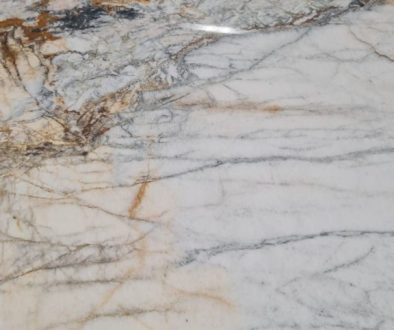
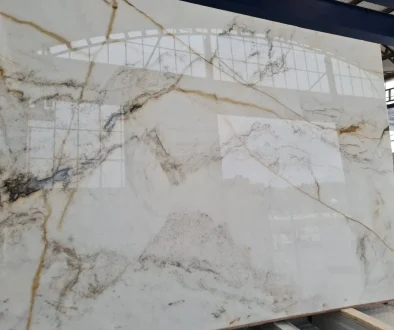
Calacatta marble is defined by its luminous white background often brighter and more refined than Carrara marble threaded with bold veins of gold, silver, or deep charcoal. The veining is organic and unrepeatable. Light interacts with the stone’s crystalline structure in a way that creates depth and warmth, shifting subtly as the angle of illumination changes throughout the day.
Engineered quartz has invested heavily in replicating this aesthetic, and some products achieve a convincing surface impression at arm’s length. But in person, under natural light, the difference between a geological material and a manufactured one becomes clear. Quartz patterns are consistent from slab to slab a feature in some contexts, a limitation in others.
For projects where visual distinctiveness, material authenticity, and architectural presence matter and in premium residential and hospitality settings, they always do natural marble vs quartz is rarely a close contest on purely aesthetic grounds.
Maintenance Requirements
Quartz is the low-maintenance choice. Wipe it down with mild soap and water, avoid abrasive cleaners, and the surface will remain stable with minimal effort. No sealing is required at any point in its lifecycle.
Calacatta marble requires intentionality. Annual sealing or biannual for heavy-use kitchen countertops maintains its resistance to staining. Spills, particularly from acidic liquids like citrus juice, wine, or coffee, should be wiped promptly. The surface should be cleaned with pH-neutral products rather than harsh chemicals.
The trade-off is this: quartz demands almost nothing of its owner, but offers no path to restoration when it shows age. Marble responds to care, can be brought back to pristine condition by a professional, and can develop a characterful patina over decades that many owners come to prize.
Calacatta Marble vs Quartz for Kitchens
The kitchen is where this comparison becomes most practical and most personal.
Quartz is the pragmatic choice for high traffic family kitchens where young children are involved, spills are frequent, and ease of care takes priority. Its resilience under daily stress is genuinely impressive and makes it a responsible specification in those contexts.
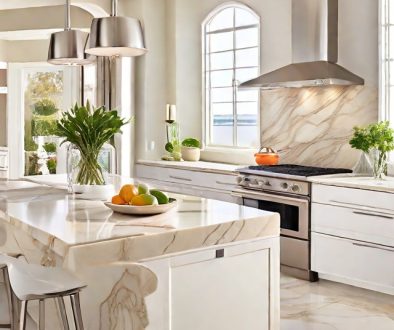
Calacatta marble is the choice for kitchens designed as design statements spaces where the material is part of the architecture, not just a functional surface. Professional chefs have long favored marble for its naturally cool temperature, ideal for pastry work. Design-focused homeowners appreciate that a marble kitchen becomes a conversation piece that deepens the character of a home over time.
The practical reality is that properly sealed Calacatta marble holds up very well in daily kitchen use. The difference is not whether marble can perform in a kitchen it can but whether the owner is prepared to engage with the material on its own terms.
When Quartz Makes More Sense?
A credible comparison must be honest about the contexts in which quartz is genuinely the better choice:
- Rental properties and commercial spaces where practicality and ease of tenant maintenance take absolute priority.
- Outdoor kitchen installations are not suitable for quartz due to UV sensitivity, but in indoor commercial kitchens with extremely high-volume, high-impact use, quartz can be the more practical specification.
- Households with very young children where the owner is not yet ready to engage with marble’s maintenance requirements.
- Budget-constrained projects where the cost premium of Calacatta marble is genuinely prohibitive.
- Projects where slab-to-slab consistency is paramount for instance, large hospitality projects requiring exact color matching across hundreds of square meters.
For all of these situations, high-quality engineered quartz is a sound, professional choice. The goal is always to match the material to the project’s priorities not to force a premium specification where it does not serve the client’s actual needs.
The comparison between calacatta marble vs quartz ultimately reflects two distinct design philosophies: the engineered and the natural, the consistent and the singular, the convenient and the consequential.
Quartz is an excellent material. It is practical, resilient, and widely accessible a credible choice in the right project context. But for spaces where design ambition, material authenticity, and lasting value are the primary brief, natural Italian Calacatta marble remains the benchmark. It is the surface that has defined luxury interiors across centuries and continues to do so in 2026 not through nostalgia, but because nothing manufactured has yet matched what the earth produces.
If your project deserves the finest and you are ready to care for a material that will reward that care for generations begin with the stone.
Calacatta Murano supplies hand-selected, Italian-origin stone to architects, designers, and discerning homeowners across the United States and Italy. Explore our current inventory of Calacatta marble slabs each photographed in full, with detailed material specifications available for every slab.